Search This Blog

Saturday, December 10, 2005

World War II Navy "CB" Lee Wallace

The "Greatest Generation" is a growing folder in
the WWII files in the Hamilton Library's Local History Collection. In the photo above, Lee is taking a break from his duties as a member of the U.S. Navy "See-Bees"

Trenton Transit Number 616

Trenton Transit #616 at the Trenton Reservoir, 1944. The familiar cream and green colored buses were a common sight in the Trenton area for many years. The photo at left was from the collection of a dear friend, the late Leon Buker of Hamilton Township. Leon spent his entire career as a Trenton Transit bus driver.


The original photo was a black and white offset
photo which has been computer enhanced and reproduced in living color.

Friday, December 09, 2005

REMEMBER THOSE GREAT 5 & 10's?

The beautiful Trenton Times photo of Trenton's S.S. Kresge "Five and Ten" was from a 1938 Christmas ad. The original was in black and white, but thanks to modern computer technology, I was able to restore the original red sign with gold lettering, so familiar to those of us who remember Kresge's, Woolworth's, and Hamilton Avenue's Schnur's and Tracy's "Five and Dime" stores.

PLAYGROUNDS IN HAMILTON, 1938

Back in the 30's and 40's, Hamilton Township had a very active summer playground program. Crafts, sporting events, games, and other competive activities provided the local community a safe place for the children to wile away those long summer hours. This fascinating school-by-school account of the various activities will undoubtedly contain names of friends and relatives of many of today's local area residents. The photos referred to in this post are in the files of the Hamilton Library Local History Collection, and will be digitized in the future.

KUSER SCHOOL PLAYGROUND
At the recent exhibition of crafts by children the following children were commended by parents and friends for the neatness and workmanship of the articles on display: George Bade, Kathleen Britton, Freda Backes, Gloria Metzger, and Loretta Palmeire. In the paper cutter division the best work was done by Francis Dietrich, William Pieslack, George Bade, Clyde O'Dell, Gustave Napoleon, Jack Fisher, H. Fitzgeorge and Walter Britton. In the carved bracket division the winners are Evelyn Krempecke, B. Fitzgeorge, Harold Fitzgeorge, John Fisher and Gloria Metzger. In the puppet division; Gloria Jones, Peggy Parker, Kathleen Britton, Eileen O'Dell, Gloria Metager; in ship- models, B. Mcllhenny, L. Harmon, B. Fitzgeorge, Francis Dietrich, William Pieslak, Clyde O'Dell, Louis Bitter and Raymond Fumo; potholders and can covers, Dolores Britton, Bernice Krempecke, Patsy Nacket, Virginia Bocco, Anna Palmeiri, Marie Mains, Agnes Cooper, Eileen O'Dell, Margaret Young and Kathleen Ferguson.
Boys and girls who won ribbons at the county and township track meet were Peggy Parker, Louis Ritter, Robert Suydam, B. Culliton, Thomas Jabolinski, Francis Bargar and Francis Mitlarich.
The boys' singles quoit tournament was won by John Turner, with Pete Ketterer as the runner- up. Gloria Metzger is the girls' champion quoit pitcher and also the shot-put champion.
Pete Ketterer also won the baseball throw for distance and the javelin championship was taken by Ridgeway Reppart.
WILLEY SCHOOL PLAYGROUND
The children who are going to receive prizes for having scored the most points for attendance, cooperation and good sportsman- ship on the playground are: Margaret Flannigan, Jim Flannigan, Earl Legg, Loretta Legg, Doris Grundaho, Margaret Ferry and Joyce Brenner. The instructor wishes to extend her thanks to the children for having helped her so efficiently during the playground season.
The playground will he open until Thursday from 7 to 8:30.
The life-saving classes will finish with their swimming instructions next week. Three boys are taking the junior course and six the senior course.
FARMINGDALE SCHOOL PLAYGROUND
Farmingdale showed to advantage in the recent township track meet, finishing in second place and was rewarded with a handsome trophy. Several of the boys and girls won ribbons. The softball team was a little bit more successful than the track team and succeeded in winning the championship of Hamilton Township by defeating the boys from Hamilton High Playground. ENTERPRISE PLAYGROUND
The boys of the playground gave a very good display of thets ability at the township meet. Robert Hutchinson, Angelo Taglarino, Chris Cerino, Robert Sieda, Joseph Scopelletti, Anthony Gevanay and Joseph Cerino received ribbons for their efforts. A very interesting craft exhibition was held last Monday evening at the Enterprise Fire House Auditorium by the children of the playgraund. Phyllis Martin, Jane Pasint and Joseph Di Memmo were awarded prizes for their good work during the playground season.
The Klockner Girls' Dramatic Group presented the play, "The Combing Jacket" at the Greenridge Theatre in Cadwalader Park last Thursday evening and were received very enthusiastically. The girls are busy with preparations for the first Fall meeting which will be held in the very near future. The girls who took an active part in the play were Johanna Orban, Margaret Orban, Betty Pasint. Thelma Anton, Evelyn McCullie, and Ronnie Bergen.
KLOCKNER
Classes in crafts and tap and social dancing, quiet games and other recreational activities are being planned for the children in the Klockner section as part of the Winter program.
HOMEDELL PLAYGROUND
The playground held closing night last Tuesday with a great success.
Members of the doll parade were Beverly Carson and Beverly Makesk. The cracker eating contest winners were Thomas Corelli and Ernest Berrish, while Michael Bearse displayed the greatest appetite in the pie eating contest and naturally was declared the winner. Music was furnished by Nancy Carmagne on the accordion, and vocal solos were rendered by James Coyle and Jean Hackney. A question box contest was held, and Nancy Carmagne, Edith Reeves and James Coyle were declared the winners.
The "Homedell Aces" girls' softball team at the
Homedell School playground.
Front row: Winnie Russell, team captain and Frances Nardi.
Second row: Jean Hackney, Jean Hoagland and Mabel Thron.
Third row: Edith Reeves, Mary Gausz, Alice Golding, Grace Virok, and Grace Probert, instructor.
The playground gave a very good account of itself in the township meet. Winnie Russell, Toots Johannes, Jean Hackney, Frances Nardi, Dorothy Petrowsky and Lou Adelman were point and medal winners.
The girls' softball team was presented with a trophy by the recreation committee for winning the Playground Softball League championships, and this is the second consecutive championship season for the Homedell girls.
MAPLE SHADE PLAYGROUND
The regular Summer session was brought to a close last Thursday afternoon with a doggie roast held on the grounds. After re- freshments were served awards were presented to Fannie Abatto and Violet Minch, the two girls who compiled the highest number of points for cooperation, sportsmanship and ability during the season. Clifford Duncan and Junior Scales received the same prizes for the boys.
HAMILTON HIGH SCHOOL PLAYGROUND
Boys and girls from this playground enjoyed a very successful day at the township frack meet. The track team, under Angelo Macchia, scored an impressive victory, proving its superiority over the other playgrounds by winning this event, and were the recipients of a beautiful trophy. Outstanding work was done by A. Macchia, V. Williams, C. Gedney and R. Andersack, and they were rewarded with ribbons.
The boys' baseball team won the township playground champion- ship by defeating the boys from Farmingdale in a hard-fought game. For their efforts they received a handsome trophy.
DECOU SCHOOL PLAYGROUND
Plans are being made to form a boys' soccer team in the Fairview District. Two teams will be placed in the Table Tennis League this Fall. The age limit in the first division will be 14 years, and the senior division will be from the ages of 15 to 21. The boys will play their first home games at the De Cou fire house.
The girls' softball team enjoyed a pleasant day's outing at Penn Valley last Friday.
YARDVILLE SCHOOL PLAYGROUND
A large group of boys and girls enjoyed a hike which was held yesterday afternoon. Plans are being made to form a boys' basketball team in this section.

Tuesday, December 06, 2005

"End of the Line"


A Trenton Transit bus approaches the intersection of South Olden Avenue and Whitehorse-Mercerville Road in this circa 1950 photo. Today it's a busy intersection, but when this photo was taken there was a Citgo station on one corner and an Atlantic station on the other. An office complex replaces the wooded area in the area across Whitehorse-Mercerville Road.

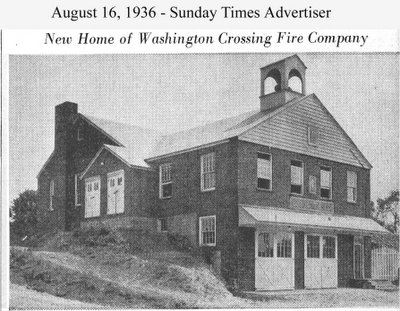
A Very Familiar Titusville Area Landmark

The capton on this photo read as follows:
FINEST FIRE HOUSE
The new home of the Union Fire Company of Washington Crossing and Titusville, is regarded as the finest fire house in this section and will be officially dedicated soon. The colonial styled structure is of brick and is located halfway between Washington Cross­ing and Titusville.
It has a fireproof engine room 20 by 20 feet, a meeting room of the same size and an auditorium 40 by 80 feat on the second floor. In addition there is a large kitchen equipped with all modern appliances. On the side of the building facing the River Road is a tile bust Of George Washington and under it the name, "Union Fire Company." The bust and name plate are the gifts of Herman C. Mueller, of Trenton, president of the board of trustees of the School of In­dustrial Arts, who has a Summer home at Washington Crossing. The building committee in charge" of construction work included: Walter H. Hankin, architect; William H. Blackwell, chairman; Raymond H. Cadwallader, Isaac B. Lipman, J. Hart Smith, George Barnhart, Lambert Cadwallader, and Fire Chief Herbert N. Scudder.

Monday, December 05, 2005

1943 - Nottingham VFD Hamilton Square


This photo is from the Trenton Times of March 14, 1943. It is a photo of the past presidents of the Nottingham Volun­teer Fire Company. They were honored by their fellow firemen in recognition of their service to the company since its incorporation in 1925. Every past president was living in 1943 when they sat for this photo. Front row, left to right, Elmer E. Everett, Thomas A. Mostyn, W, Albert Grove, Harold J. Jemison, George H. Hutch­inson, Amzi A. Cubberley, John C. Cubberley, Dr. Frederick B. Zandt; back row, President John P. Arthur, W. Harry Cartlidge, Joseph F. Mealy, Marvin H. LaBaw, Clifford E. Coleman, Joseph Ferry, Theodore A. Cubberley, Harold Snedeker and Irving R. Grove.
Tom's note: The original of this photo is in the "Hamilton Square" file at the Hamilton Township Library Local History Collection. Space constraints on this site do not allow for the reproduction of the photo in its actual size.

Sunday, December 04, 2005

GROVEVILLE: A CERTAIN CHARM

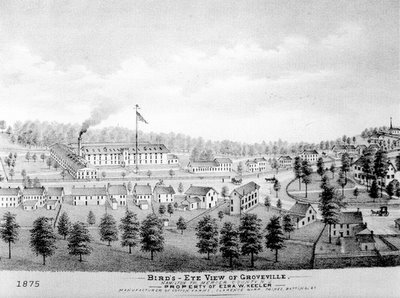
Mayor Glen Gilmore’s administration recently converted the run down “Morris Mills,” Anchor Thread Company property into a community park. In its heyday the textile mill was a major employer of local Groveville residents. The engraving accompanying this post is from Evert and Stewart’s 1875 Atlas. It is an exquisite bird’s eye view of the town looking north toward Yardville.

August 17, 1898, From the Daily State Gazette: A gentleman signing his name only as “Howard” takes a trip from Yardville to Groveville.
(The parenthetical notes are Tom’s notes to clarify persons, places and things referred to in the original article.)

Leaving the village of Yardville at the creek close to Kirby's Mills,
(Gropp’s Lake) it was quite a little ascent for the stranger to reach the adjoining country, which is known as Groveville. The scenery around this section is very romantic; ­a section suitable for study by the nat­uralist, the botanist or for any branch of science of a kindred nature.
At the end of a few moments' jaunt the first point of attraction that caught the eye was the spire of the village church, (Groveville Methodist) a beautiful edifice, newly constructed, neat in appearance and of modern build. In the church yard there were noticed the mounds of many of the departed, dotted here and there with an American flag, denoting the resting place of a departed comrade who when alive had done service for his country.
Leaving the church premises I soon reached the village proper. Turning to the left I proceeded far enough to observe the erection of a tent which had been recently used by the church people for a harvest home. Retracing my steps I proceeded to the other end of the village, and dur­ing the stroll I was pleased to see a number of small American flags at­tached to the front of the dwellings. The dwellings of Groveville are built rather close together, more so than in Yardville. These dwellings are chiefly occupied by the operatives of the mill.
The general store is located in the lower end of the village opposite the mill. The store is well stocked, as there are also the other stores in the same community. Proceeding in the direction of the mill my attention was arrested on viewing a very handsome residence prominently located in the village centre, the grounds surrounding this mansion being exceedingly attractive. These promises I was informed, were occupied by Mr. Morris, the proprietor of the mill.
The cotton mill of Morris & Co., so well known as the Groveville Mills, are among the most extensive of the kind in the state. These mills have been continuously favored with full orders, and I have been informed that they have orders ahead at this date. The product of those mills have al­ways found a ready market. Through panic after panic these mills have given steady employment to the indus­trial element of the village. These works cover a large space of ground and favored with every facility for the uninterrupted running of the plant, and it is to hoped that this same industrial prosperity will continuo to remain within the borders of the
village for many years to come.

Saturday, December 03, 2005

Bromley: One of Hamilton's Older Neighborhoods


As a Bromley resident for more than 45 years, I am very interested in the genesis of this community.
A large part of the area we know as Bromley included the Fashion Stud Farm of Henry N. Smith. Smith died in 1901. After his death, his heirs formed a land company and Mr. Edmund C. Hill purchased acreage between Nottingham Way and Greenwood Avenue and called the development “Bromley Place.” The land across Greenwood Avenue was purchased by the H.J. Miller Realty Company, who developed “Bromley Manor.” Another section of Bromley, between Connecticut and Atlantic Avenues, on the north side of Greenwood Avenue, was the site of the old George Anderson Farm.

(Tom's note: The engraving above is from 1911.
It has been computer enhanced and colorized.)

Monday, November 28, 2005

Calhoun Street at the Bridge - 1948


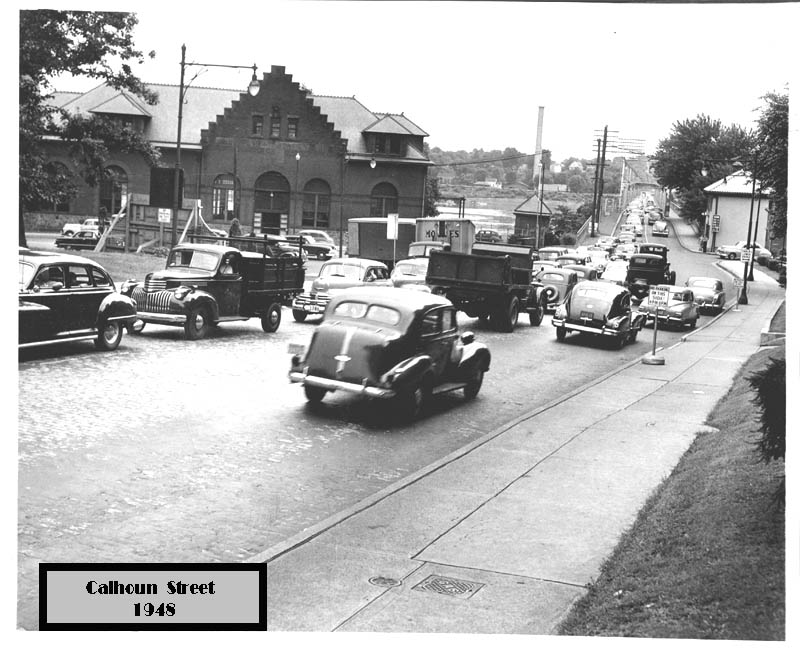
You are on the other side of 50 if you remember when Calhoun and West State Street appeared as in this 1948 photo. The old Trenton Filtration Plant is the building in the left background.

Do You Remember the RKO Hamilton?


Christmas Day, 1946. Hamilton township proudly announced the opening of the new RKO Hamilton theater. It was located on South Broad Street. The building is still there, now the home of a local church. "Canyon Passage," starring Dana Andrews, Brian Donlevy, and Susan Hayward was the premier presentation. Unfortunately, a few years later, television would come on the scene and the movie going public migrated away from the silver screen.

Sunday, November 27, 2005

Holy Angels School's First Graduates

MONDAY, JUNE 18, 1923
THE FIRST GRADUATES OF HOLY ANGELS SCHOOL
Commencement exercises of the Holy Angels School were held last evening in the church, when thirteen pupils were given their certificate which mark the completion of their grammar school studies.
The program was opened by a hymn of thanksgiving to the Sacred Heart, and this was followed by a hymn in honor of the Blessed Virgin. The Rev. John F. Walsh, pastor of the church, gave a stirring address, and then presented the pupils with their diplomas. The program was closed with benediction of the Most Blessed Sacrament,
Diplomas were given to Misses Katherine Dalton, Margaret Cleary, Helen Peeney, Marie Chinery, Margaret Stevenson, Caroline Brooks, Catherine Ward; Vincent Weiss, William Hogan, Fred Wollman, Benjamin Walters, Philip Booz, and Charles Mullen.
Medals given by Vincent P. Bradley to the pupils with the highest and second highest class average In the eighth grade were awarded to Katherine Dalton and Vincent Weiss for the highest average, and to Margaret Cleary and William Hogan for the second highest. A medal given by the Holy Name Society of the church to the pupil whose deportment and general helpfulness to the school has been exceptional during the year, was awarded to Benjamin Walter. The medal given by Father Walsh to the student having the highest average in the seventh grade was awarded to Elizabeth McClain, who also received the Palmer diploma for penmanship.
Father Walsh selected for the text of his address that portion of Scripture, “He that instructeth others unto Justice shall shine as the stars for all eternity.” He declared that the parish was especially proud of these its first graduates and would watch their climb up the ladder of education with interest and best wishes for success.
Speaking of the great need of parochial schools, Father Walsh cited Trenton as an instance where the Church, as a great friend of the State, has relieved her of the education of 9.000 children in this city alone. With schools crowded as they are at present if the parochial school children were to ask for admittance, the school situation would be unimaginable. He declared that the parochial schools are founded to develop the two component parts of the child, the soul and the body, and for this reason noble women consecrate their lives. Without the aid of the Sisterhoods, it would be Impossible to maintain the many schools throughout the country because there would be no funds to pay the salaries which would then be necessary. As it is now the Sisters ask but for food and shelter and, as Father Walsh pointed out, during the past year the Sisters of the Holy Angels School had not even a home for each day they were transported from St. Francis Hospital to the school.
Father Walsh declared that in closing he could apply no more beautiful word to the sacrifice and work of the Sisters than the word of the infallible God who declared that “He that instructeth others unto justice shall shine as the stars for all eternity.”

Friday, November 25, 2005

KUSER SCHOOL - HAMILTON WEST: PERFECT TOGETHER


I have been particularly interested in the schools of my youth. For more than 50 years, I have avidly sought anything and everything relating to my Kuser grammar school and Hamilton High school. Today, with the incredible changes which have transpired in public education, a look back at what I term "the golden years of education" proves to be quite interesting. Two of the most extensive folders in my local history collection revolve around my very happy years as an alumnus of Kuser Grammar School, and Hamilton High School, or as we call it today "Hamilton West." Indeed over the last 25 years, I have written numerous columns on my happy years as a student in the Hamilton Township educational system.

HAMILTON'S FRIENDSHIP SCHOOL

Not many people are aware that Hamilton Township once had a school known as the "Friendship School." It was located atop the western side of Cedar Lane hill, near the site of the Korzilius Monument company, and the prison cemetery. This transcription from an 1895 "Daily State Gazette" tells of the demise of one of Hamilton's original schoolhouses. It is interesting to note the frugality exhibited by the school board of those years gone by. Rather than purchase new furniture, it was decided to divide the old furniture from the closed school and divide it among the new facilities.
************************************************************************
The old Friendship schoolhouse and grounds on Cedar street, just beyond the Eleventh ward, which has been the source of much controversy and some litigation in Hamilton township for the last year, are to be disposed of at public sale on the 30th inst.* (August, 1895) This was decided upon yesterday by a unanimous vote, at a special election of the voters of Hamilton township school district, held at the schoolhouse in question. It was also decided that the proceeds of the sale should be devoted to purchasing furniture and other supplies for the new Hutchinson school and the new Rusling school, which are to be built upon the Homedell tract and at Broad Street Park, respectively, to take the place of the Franklin street school, which was not only too small but so dilapidated that its condemnation has been more than once threatened.
Before the passage of the township school law of 1894, the voters of the Franklin school district decided to build a new schoolhouse on the site the old one, but General James F. Rusling, who was interested in having a schoolhouse at Broad Street Park, which was in the district, certioraried the matter to the Supreme Court. When the township school law was passed and the district became absorbed in the Hamilton township district and it was found that the Friendship schoolhouse was too small, an annex was established in rented rooms on the Homedell Tract. Since then, Symmes B. Hutchinson, representing the Homedell Land Association, agreed to build a schoolhouse upon the Homedell tract if the township school authorities would rent the same, and General Rusling offered to build another at Broad Street Park on like conditions Both of these propositions have been accepted, so that when the school year opens in September the Franklin school will be a thing of the past, and instead there will two schools: one at Broad Street Park, and one on the Homedell tract. The former will be known as the Rusling school, and the latter as the Hutchinson School. In addition to devoting the proceeds of the sale of the Franklin School to the purchase of furniture and other supplies for the new schools, the old furniture will also be equally divided between the two new schools.
The teachers of the new schools will be those who taught at the Franklin school, and the Franklin school annex. Miss Clara Morgan of Hamilton Square has been assigned to the Hutchinson school, and Miss Margaret B. Hunt, of Groveville, to the Rusling school.
*"inst." was commonly used by journalists to designate a day. eg:
March 16th would be written as the "16th inst."

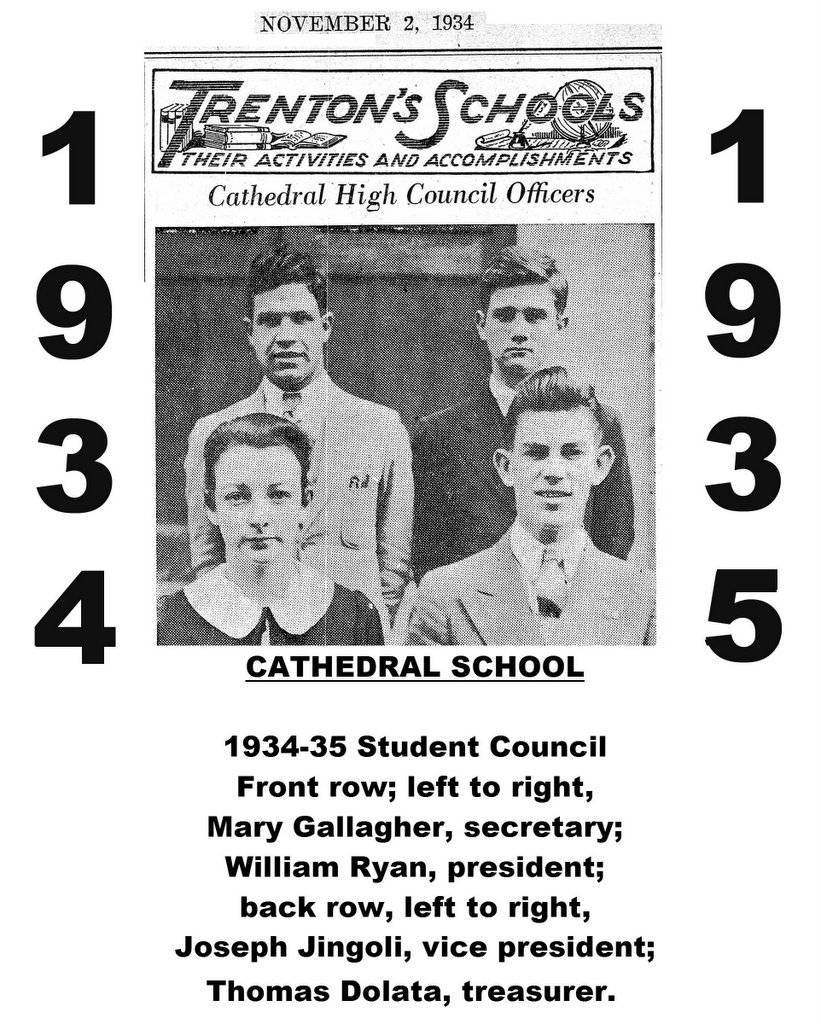
CATHEDRAL SCHOOL - 1934 -1935

Thursday, November 24, 2005

HAMILTON'S HOMEDELL NEIGHBORHOOD


There are numerous files on Homedell in the Hamilton Library Local Collection files. This is one of them:
The area known as Homedell is located in the general area of Liberty, Redfern, and East Franklin streets. The land in that area was once a part of huge land holdings of the Hutchinson family. Symmes B. Hutchinson was a prominent resident of Hamilton Township. (Hutchinson Street at the foot of Cedar Lane Hill is named for the family)

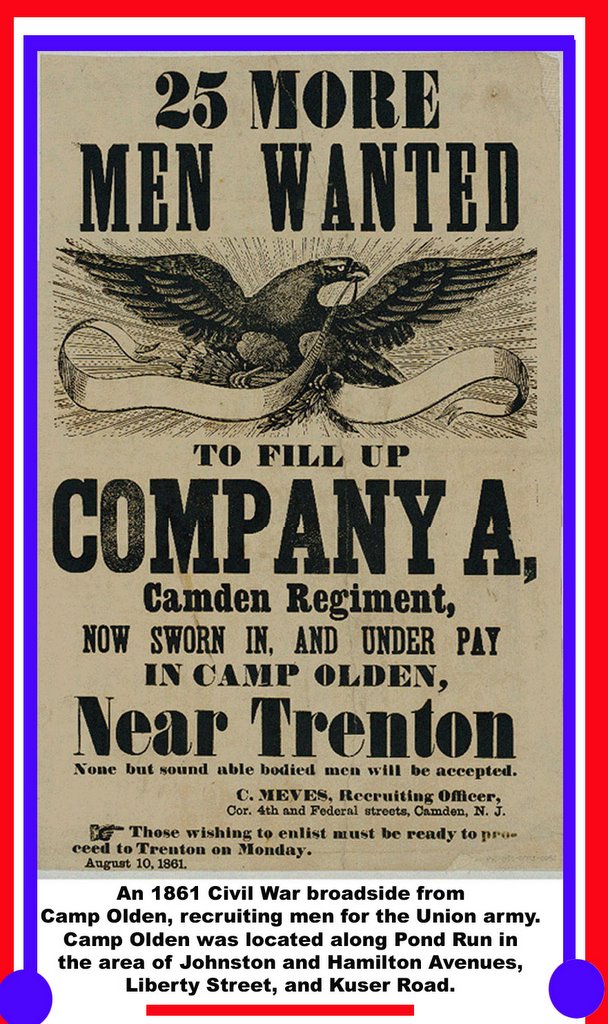
OUR ELUSIVE CAMP OLDEN BORDERS

CAMP OLDEN
By Tom Glover
Definitive information on Camp Olden has proven to be quite elusive. The exact boundaries of Camp Olden are not known. However, the area surrounding the intersection of Hamilton Avenue and Liberty Street is the location of at least a portion of the camp. According to an un-dated article from the local press, the camp contained 68 acres. What is known is that at least a portion of the camp extended from Hamilton-Liberty-Johnston area eastward along Pond Run, including the land on both sides of the creek. A number of lead “mini-balls” have been unearthed in the open fields in the area.
That Camp Olden was located in the Hamilton-Liberty-Johnston Avenue area is borne out in this Civil War veteran’s reunion notice from a 1905 article in the Trenton "Daily State Gazette:
“The members of Aaron Wilkes Post, G.A.R., held an outing at Henry Lawton’s Farm, Hamilton Township yesterday. The farm was known as Camp Olden during the Civil War, and many companies of New Jersey regiments were recruited there. The members of the Women’s Relief Corps No. 7 participated in the outing. There were about 100 persons present.
Prior to 1905, the land was in the hands of the Steward family, as evidenced by this extract from the year 1892:
“Seventeen properties of the Jonathan Steward estate were disposed of at public sale by Assignee George W. Whittaker, for fair prices in the Board of Trade rooms yesterday afternoon. J.H. Cotton was the auctioneer, and ex-judge William M. Lanning announced the conditions of sale and dimensions of the properties. A large number of prominent business and professional men were present the bidding was both active and interesting,
The first property offered for sale was the undivided one third interest in the Camp Olden Farm, comprising about 68 and three quarters acres, a small two story frame dwelling and barn, located in Hamilton township, near Pond Run, and fronting on the easterly side of the road leading from Pond Run to Lamberton. (Note: “The road leading from Pond Run to Lamberton” would be today’s Liberty Street, which terminates at Lalor Street, a few blocks south of what was the area of South Trenton then known as “Lamberton.”
The barn referred to is very possibly the building which we neighborhood kids thought was haunted. It was located off Hamilton Avenue, near the Ward Avenue intersection. There were two mortgages on the Camp Olden property, amounting to $1,400. It was purchased by A.G. Richey for $1,600.
Apparently the Camp Olden Farm was originally in the hands of the Steward family; another clue to location of the camp. It is logical to assume that Steward Avenue was named for the family.
Henry Lawton probably purchased a parcel of the land from the sale described above, or from a real estate speculator at a later date. The Lawton’s owned substantial acreage in the Hamilton Avenue area. (Lawton Avenue). In 1908, the Lawton family sold the land on which Kuser School is built to the township of Hamilton. Somewhere in my collection is a copy of a hand-written receipt, signed by Mr. Lawton, acknowledging sale of the property for one dollar.
New Jersey citizens flocked to the colors when the Civil War broke out in 1861. There’s an interesting local story that certainly bears re-telling. One of New Jersey’s noted military organizations was the First New Jersey Brigade, under the command of Phillip P. Kearny. The Brigade fought bravely in the war between the states.
Among the local citizens who were part of the brigade were the very same Henry Lawton referred to above. Lawton was one of a company of Trenton area men who joined the New Jersey Brigade. He was one of many English-born potters who worked at the City Pottery, then located on Perry Street, along
the canal. As a point of reference, the canal crossed Perry Street at about the same juncture as today’s Trenton Freeway. Lawton and his fellow potters were immediately sent out to Camp Olden to be mustered into military service, and became known as the “Potter’s Company.”
Prior to the opening of Camp Perrine, Camp Olden served as the mustering in location for the first nine regiments of Jersey troops to go to war. In an interview in 1910, Henry Lawton said that there were more “three month men” mustered in at Camp Olden than at any other camp in New Jersey.
Camp Olden was named in honor of Charles Smith Olden, who was the twenty first governor of the state, having served from 1860 to 1863. For some reason, historical data on the camp is very elusive. However, confusion over at least a portion of the camp has been established; thanks to various articles which appeared in the local papers during the first twenty years of the twentieth century.
Following is an extract from a “Trenton State Gazette” article from 1922. It tells of a reunion which Henry Lawton, his brother Joseph, and John P. Beech attended, as members of the Grand Army of the Republic:
Henry Lawton, along with Joseph Lawton and John P. Beech, and two other Civil War veterans, who served as members of the “Potter’s Company,” tried to place an historical marker on the site on which they received their initial training as Union soldiers. Unfortunately, the project never came to fruition. The following appeared in the Trenton State Gazette, September 11, 1922:
“As the Wilbur section of the city can boast of no memorials, it is believed that what historic association there is to offer should at least be of interest to the residents and an asset to the section. The plan to mark the site of Camp Olden is not a new one, a project to the same effect was brought up a number of years ago before the members of the G.A.R. by Henry Lawton, who is a member of Aaron Wilkes Post.”
There was an interest in the project for a time, but it gradually died away, through the lack of support among the members of the veterans’ association. During the reunion of 1910, the matter was again brought up by Mr. Lawton before his associates; this time with support from the residents who lived in the area. Once again the effort failed.
Henry Lawton’s Plans called for the creation of a small park in the center of Johnston Avenue. He envisioned it as being oblong in shape, and running from Johnston Avenue to Hamilton Avenue, and continuing toward Liberty Street. His plans included a landscaped plot of land fronting on Hamilton Avenue, with a huge boulder of plain granite marker with a bronze tablet marking the location of the camp.
HENRY LAWTON
Henry Lawton was wounded and captured at the battle of Gaines Mills on June 27, 1862. He was held captive at the notorious Libby Prison in Richmond, also spending some time as a prisoner at Pemberton Prison and the Confederate prison at Bell Island, all in the Richmond area. After spending an unspecified length of time in the aforementioned prisons, Lawton was repatriated with 2,000 Yanks in exchange for a like number of Rebels. Upon his release, he was sent to General McClellan’s headquarters at Harrison’s Landing, where he was re-outfitted and returned to his comrades in the “Potter’s Company.”

Wednesday, November 23, 2005

Bromley World War II Veterans

An extract from a 1943 program donated to the Hamilton Township Public Library Local History Collection by noted local historian, Mary Alice Quigley. The program honored the veterans listed in the graphic shown below.

Charles Conrad Abbott's "Meadows"


MONDAY, JULY 3, 1893
THE BEAUTY OF BROAD STREET PARK AND “THE MEADOWS”
Among the numerous near by places where a day’s outing can be obtained readily and cheaply, Broad Street Park is worth a passing notice. Having an hour or two to spare on Saturday, the writer boarded an electric car, and in a few minutes was set down at Harrison Avenue, the entrance to the park. and a walk of a very few minutes sufficed to reach the park itself, and enjoy a view of nature unadorned. The scenery at the park is quite diversified, consisting of highland, lowland, lake, field and forest. On the bluff is located the Overlook House, on the spacious verandah of which cool breezes constantly play, and on Saturday Winkler’s orchestra for an hour or two discoursed a number of choice selections. Near the mansion in the cozy groves are located tables and seats painted a vivid red an yellow, designed for the use of picnic parties.
The view from the bluff is somewhat restricted because of the thick growth of trees and underbrush, which while it affords abundant shade, interferes with the view of the lake and the long low lying levels toward the river. The visitor may descend the bluff by means of the terraced stairs, in easy stages, by the road that winds down with many a turn, and angle. In passing down the steps the visitor reaches the side of “Spring Lake,” which is supplied by springs, with which this locality abounds; in fact almost at the foot of the stairs is Silver Spring, affording an abundance of pure water cold as ice and distilled fresh from its rock-bound recesses. As one passes along Lakeside pathway other springs come in view bearing beautiful names. This pathway runs along the northern edge to its southern side, and then along in that direction until the ramble is reached, where the path diverges to the left beneath old forest trees grown heavy with age, and the real beauty of the place appears. Seats and tables are scattered about, and the debris lying around indicate that many a picnic party has had good times here. Passing over the Suspension Bridge, the Boiling Spring is reached, where the water boils up, cold as ice, and causes the white sand through which it forces its way to bubble as it in a cauldron. The meadows are covered with a luxuriant growth of red and white Boneset and other wild flowering plants, which present a beautiful appearance when in full bloom. If now wearied with walking, a boat is readily procured, and a row on the lake, covering twenty six (acres ?), is an enjoyable way of passing an hour, or if your taste runs to fishing, you may gratify that at the same time. Water lilies and other aquatic treasures may be secured with but little effort. Wearied perhaps, with all this, you ascend the bluff, and there are swings inviting you to a dreamy siesta, or seated on the comfortable seats on the terrace you can feast your beauty-loving eyes on the attractions spread before you. A number of the city Sunday schools have already engaged days on which to enjoy their annual picnics and the youngsters say they always have a good time when they go to the Broad Street Park.

A DEMOCRATIC OX ROAST CELEBRATION

HAMILTON SQUARE - November, 1892
Local Democrats converged on Hamilton Square at 7:30 Thanksgiving evening for an ox roast and parade, celebrating the recent victory of Grover Cleveland and Adlai Stevenson to the Presidency and Vice Presidency. After a dinner featuring roast ox sandwiches, a torch light parade with uniformed marchers was held.

Mercerville: Alias "Sandtown"

TUESDAY, JANUARY 2, 1877
1877: SANDTOWN - REVOLUTIONARY WAR - QUAKER BRIDGE
TRENTON DAILY STATE GAZETTE
The citizens of Sandtown will feel slighted if the Continental troops do not march through that place some time during the night preceding the battle of Princeton. Elias Phillips of Lawrenceville, Patrick Lamb of Quaker Bridge, and Ezekiel Anderson guided the patriot army from the banks of the Assanpink at Trenton through Sandtown and over the Quaker Bridge to Princeton on that dark night before the battle of Princeton.
Tom's note: I have heard that a lady by the name of "Ginny Jackson" also guided the Continental troops to Princeton. Can any reader clarify?

Sister Hyacinth's St, Francis Hospital

THE EARLY YEARS OF ST. FRANCIS HOSPITAL
SATURDAY, AUGUST 8, 1874
GAZETTE
A gentlemen informed us yesterday that one of our physicians who has been visiting St. Francis Hospital in an official way, was quite enthusiastic in his praises of the manner in which the institution is kept. The hospital is the perfection of cleanliness in every part, and the attentions of the ladies are unremitting, and exceedingly kind.
There are about 20 persons now in the hospital, who each extol the manner the institution is managed. He spoke particularly of it nonsectarian character. No word is uttered, and no rule is laid down with which the most sensitive on this subject could find fault. This is gratifying, and it is still more gratifying that an institution has been founded in our midst where the afflicted can find a home, and where they find friends and all they want. The County Medical Society, by invitation have so arranged themselves in classes as to furnish to the institution regular visitations.

THE NEW HAMILTON SQUARE BAPTIST CHURCH


SATURDAY, JUNE 18, 1881
HAMILTON SQUARE BAPTIST CHURCH NEARING COMPLETION
The Hamilton Square Baptist Church will probably be ready for occupancy sometime in July. The new building is a handsome one, 56 feet front by 96 feet deep, and will have a tower and pinnacles.
The main auditorium will seat six hundred persons, and there are besides the Sunday School, classrooms and parlors. The bell purchased from the Good Will Fire Company of Trenton, will be placed in position in the belfry very soon, and will he heard for miles around calling worshippers to the House of Prayer. Since the tearing down of the old edifice, the Baptist congregation have held service alternatively in the Methodist and Presbyterian Churches at Hamilton Square.
TUESDAY, JUNE 14, 1881
HAMILTON SQUARE BAPTISTS BELL TOWER
The Baptist Church of Hamilton Square yesterday, purchased the bell of the Good Will Fire Company of Trenton. It will be removed to Hamilton Square and placed it the belfry of the new church building. The bell was one of the best fire bells in the city and might have been retained for the use of the Fire Department had the late Common Council made an appropriation to place it in a suitable tower.

MONDAY, JUNE 27, 1881
FIRE BELL ARRIVES AT HAMILTON SQUARE BAPTIST CHURCH
The fine bell of the Good Will Fire Company, which was sold to the Hamilton Square Baptist Church some time since, was removed to that place on Saturday afternoon. On reaching the "Square" the "Goody boys," who accompanied it, gave it their last ring, and so loud was its tongue that the good, quiet-going folk hurried out to see their new acquisition. It will be hanged in the belfry today.

Tuesday, November 22, 2005

Delaware Valley Radio Association

Through 74 years, the amateur radio operators from DVRA have been ready, willing and able to provide emergency communications whenever and wherever disaster strikes. DVRA Headquarters is in West Trenton at the Bear Tavern Road Exit of Route 95 South. They can be contacted at www.w2zq.com
Monday, November 21, 2005

SUNDAY, OCTOBER 9, 1938
CONSTRUCTION ON NEW SEWAGE PLANT TO BEGIN

In less than a week after bids were received, construction work on Hamilton Township's nearly $3,000,000 sewage system is scheduled to get under way tomorrow of afternoon at 3 o'clock with ground-breaking ceremonies on the site of the new disposal plant on Independence Avenue, near the old Camden trolley line. Initial contracts, let to all Trenton firms, cover construction of the disposal plant, including electrical, plumbing, heating, ventilating and structural work. Scheduled for completion within a year, the plant will be constructed at a cost of approximately $390,000. As work progresses, bids will be sought for the remainder of the construction program, which involves the laying of some 70 miles of trunk lines, semi-trunks and laterals. F. J. Parker, formerly of Montclair, is the resident engineer in charge of the Federal PWA supervision of the vast project.

TOM’S NOTE:
The PWA mentioned above stood for Public Works Administration;
a program initiated by the administration of Franklin Delano Roosevelt.

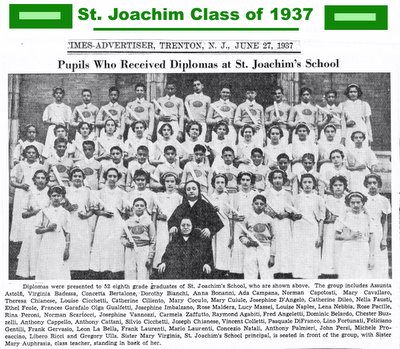
ST. JOACHIM GRAMMAR SCHOOL


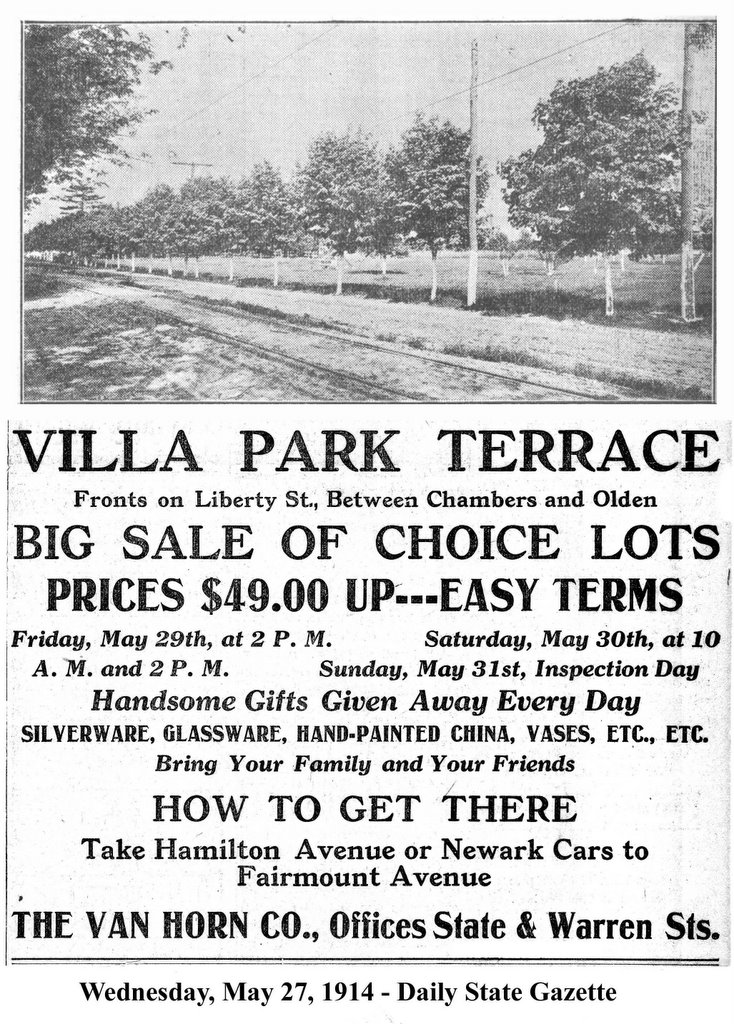
VILLA PARK: IN THE BEGINNING


1914: Real estate properties for sale at Villa Park
for as low as $49! Buy Now.

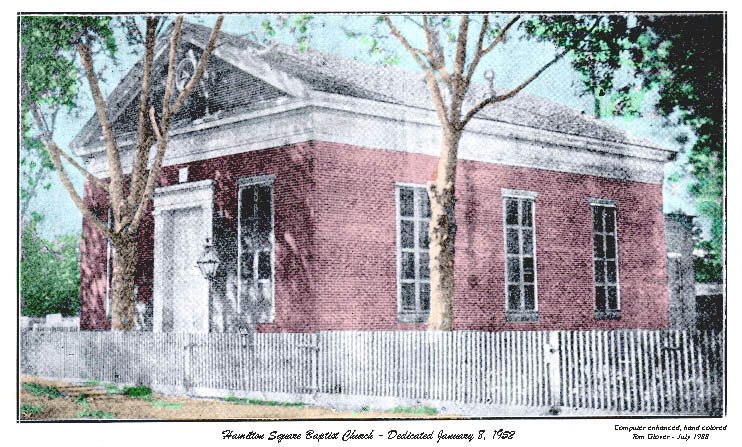
Hamilton Square Baptist Church


Once again, thanks to 21st computer technology, an old black and white photo can be hand colored and proudly displayed.

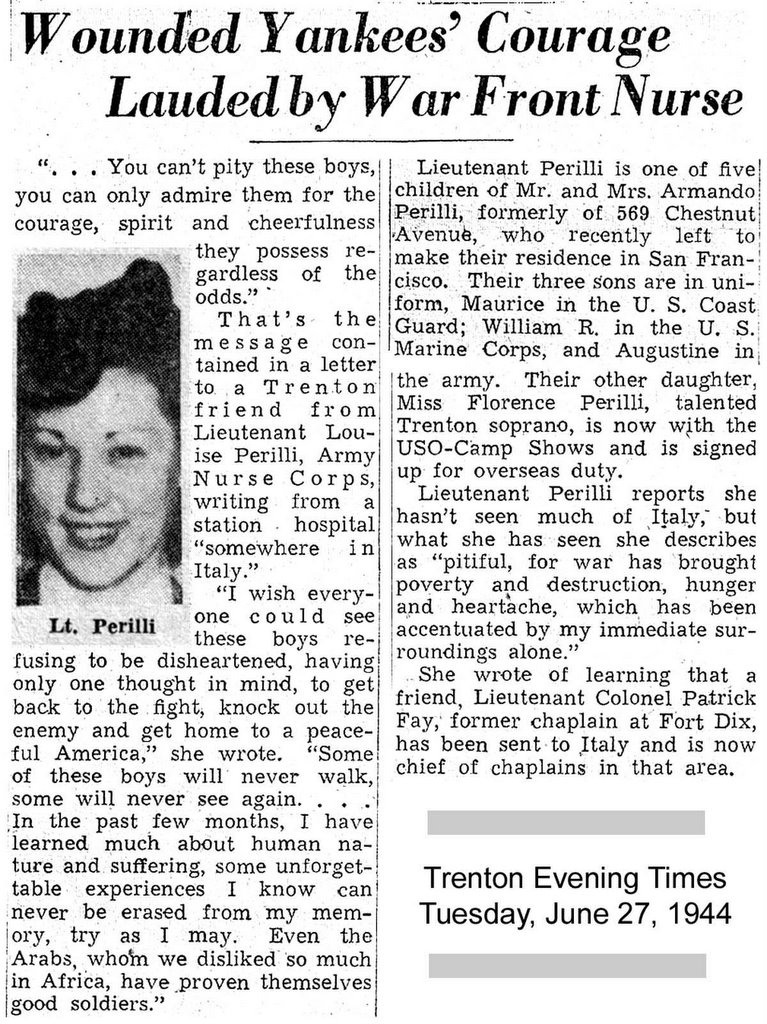
From our "Notable Persons" File


This World War II clipping shows Louise Perilli, sister of former Hamilton Mayor Maurice ("Maurey") Perilli, and Friend of the Library Gus Perilli.

"TRENTON IN BYGONE DAYS"


As a young boy, I eagerly went to the pages of the Trenton Sunday Times Advertiser to read "Trenton in Bygone Days." John Cleary and Harry Podmore made local history come to life. Their writings are a treasure trove of local history.
One of the very exciting aspects of my local history digitization project is the ability to preserve my collection of "Trenton In Bygone Days" columns. Most of the Bygone Days columns I have seen were pasted into scrapbooks, and through the natural aging process have faded and the scrapbook pages developed a "rippled" effect.
Thanks to computer technology, the pristine original newspapers in my collection allow for equally pristine reproduction of the many BGD columns available. For the benefit of the many senior citizens who are interested in history, these files are being scanned at high definition, allowing those who need large print to zoom in to a comfortable reading level.

Sunday, November 20, 2005

Old Newspapers Are the Best Newspapers!

A NOTE FROM TOM:
Many of the articles and news photos posted on this site are extracted from my collection of Trenton newspapers. They include the Trenton Times, the Daily State Gazette, and the Daily True American. Additionally, as an enthusiast of local history for many years, there are many clippings which were in the many scrapbooks I have collected over the years. I began manually transcribing this historical material before computers and scanners became available. Some of these papers are in very poor condition, and you will note that many of the transcribed articles have only the date and subject listed. Additionally, the photos from the early 20th century are quite primitive, and were produced before the offset/printing process was perfected.

St. Mary's Cemetery: In the beginning

AUGUST 21, 1876:
CONSECRATION OF ST. MARY’S CEMETERY
The new cemetery recently laid out on Olden Avenue, under the auspices of St. Mary’s Catholic Church, in this city, was duly consecrated yesterday Tbe day being very fine, a large concourse of people visited tbe place to witness the ceremony. Father Smith, of St. Mary’s Church, was deputed by the Bishop to perform the services. A procession was formed at St. Mary’s Hall, on Bank street, as follows:
St. Mary’s Temperance Society.
St. Mary’s Temperance Cadets.
St. Mary’s Beneficial Society.
Young Men’s Catholic Association.
Sodalities of St. Mary’s Church.
A number of persons were in carriages. There was no music. The ground was consecrated with the usual services,
which were of a very interesting character.
This plot contains about twelve acres, and is beautifully located. It has already been very handsomely laid out.
MONDAY, AUGUST 22, 1876:
ST. MARY’S CEMETERY CONSECRATED
The consecration of the new cemetery attached to St. Mary’s parish took place yesterday, and was witnessed by hundreds of people. The cemetery is located on Olden avenue, upon which it has a frontage of 1,000 feet. It is 14 acres in extent, and when the grading is completed will he one of the most handsome burial places in this locality. It is traversed by several 18 foot avenues, that intersect at right angles Other avenues, varying from five to thirteen feet in width, are staked out at regular intervals. At the principal entrance are highly ornamented gates, and the whole tract is
enclosed by a substantial fence.
About 3 o’clock P. M. a procession, composed of St. Mary’s T. A. B. Cadets, the T. A. B. Society, St. Mary’s M. B. & B. and the Young Men’s Catholic and Literary Association, was formed on Bank Street, and marched to the scene of the consecration. The ceremonies were performed by the Rev. Father Smith, who preached an appropriate and interesting sermon, which was listened to with close attention. He stated that from the cradle to the grave the church was the guardian of her children, and had appropriate ceremonies for all the stages and events of life, and inasmuch as their bodies were, during life, the temples of the Holy Spirit, it was appropriate that when life had fled, having died in the faith, the remains of the faithful should rest in holy ground. One of the saddest duties he had to perform, was the denial of Christian burial to those, who, by their own acts, had cut themselves off from the church. He hoped that his bearers would remember that all men must die, and would shape their lives so that when the awful change did come they would be worthy, not only to rest in the consecrated ground, but that they would obtain rest in that House, not made with hands, eternal in the heavens.
The opening of St. Mary’s cemetery will prove a great convenience to the people of that parish, and save them a vast amount of annoyance and trouble, as hitherto interments had been
made at St. John’s Cemetery, on Lalor Street.

OLDEN AVENUE TO BE EXTENDED

MONDAY, FEBRUARY 1, 1875
EXTENDING OLDEN AVENUE TO WHITE HORSE

Before 1875, Olden Avenue began its long journey northward from Hamilton Avenue. The area to the south was open farmland and woods. In February, 1875, a petition was circulated, proposing the extension of Olden Avenue from Hamilton Avenue to “Cedar Grove;” today’s Cedar Lane. The extension of the road would provide a more direct route to the southern areas of the township: Olden Avenue to Cedar Grove, then over the hill, past the Symmes Hutchinson Farm, (now occupied by many cemeteries) to Chambers Street. Future plans called for the extension of Olden Avenue all the way out to the White Horse Road.
WEDNESDAY, MARCH 10, 1875
EXTENDING OLDEN AVENUE
The surveyors and the township committee of Hamilton, met yesterday to arrange for the extending of Olden avenue, Mr. James S. Aitkin and ex-Judge Reed represented the objectors, and James F. Rusling appeared on behalf of the surveyors. A discussion took place, after, which the surveyors agreed to lay the road, and assessed damages as follows: Mr. Vreeland, $200 Joseph Wagner, $200; and to six others, 50 cents each.

CAMP OLDEN


White Horse Inn

WHITE CITY - HAMILTON'S "CONEY ISLAND"

Friday, November 18, 2005

Today it's called the "Cookie Cottage"

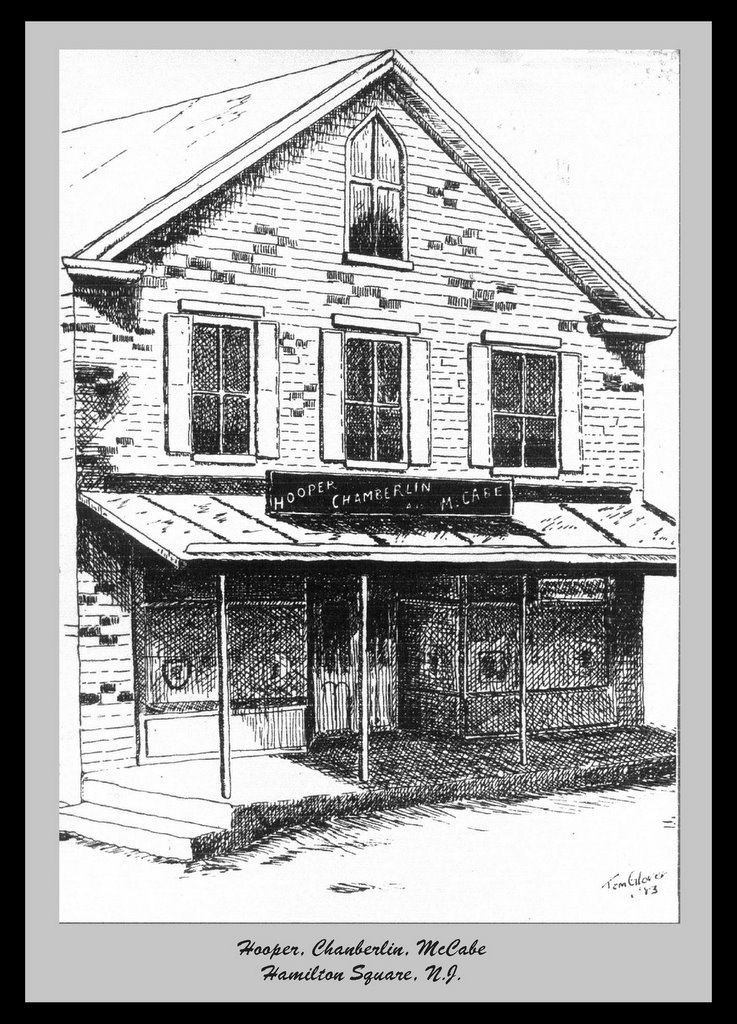
I drew the above pen and ink sketch some 20 years ago, when Mr. Chamberlain of Hamilton Square let me borrow the photo from which this sketch was rendered. Back in the 19th century, the building occupied by today's "Cookie Cottage" was the general store of Hooper, Chamberlain and McCabe. The store was the main source of groceries and farm supplies to the residents of the town of Hamilton Square, and the many farmers in the area.

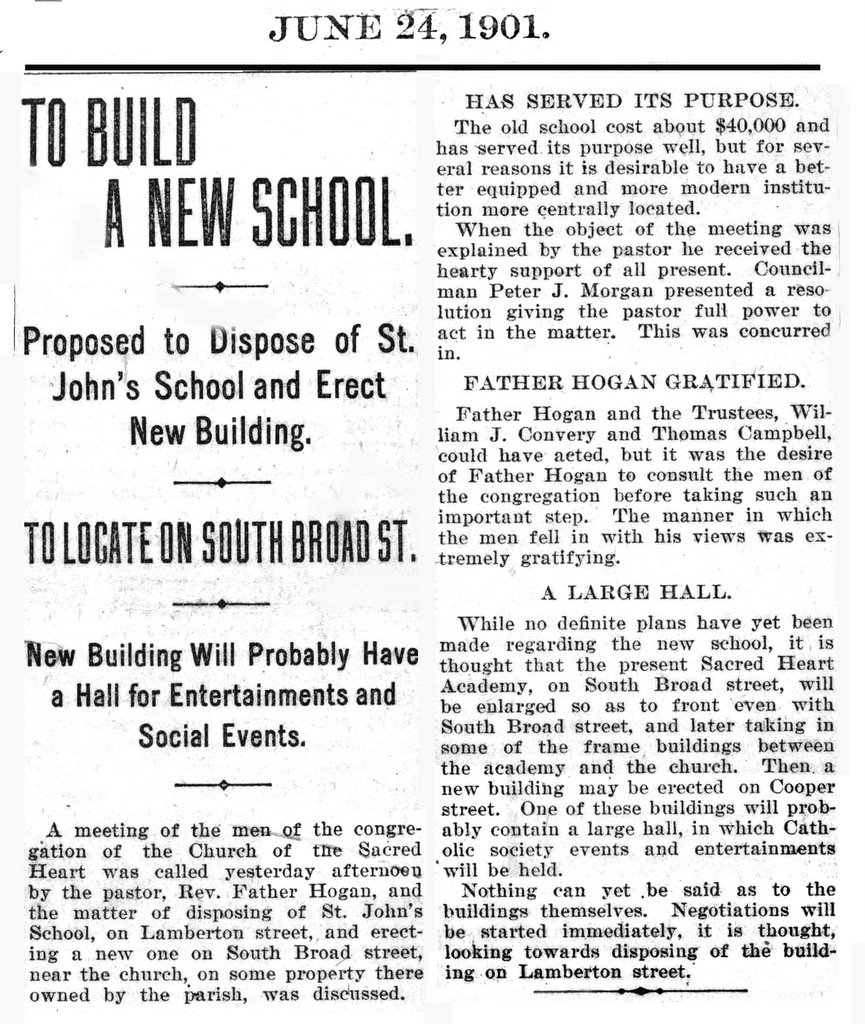
1901 - Sacred Heart to Build a New School

Thursday, November 17, 2005


Just one of the many historic buldings in Hamilton Township, built in 1892 by Frederick and Theresa Kuser. This year's "Winter Wonderland" at Kuser Farm will once again bring hundreds of visitors from all over the area. For further information, contact Curator Denise Zemlansky at the link below:

http://www.hamiltonnj.com

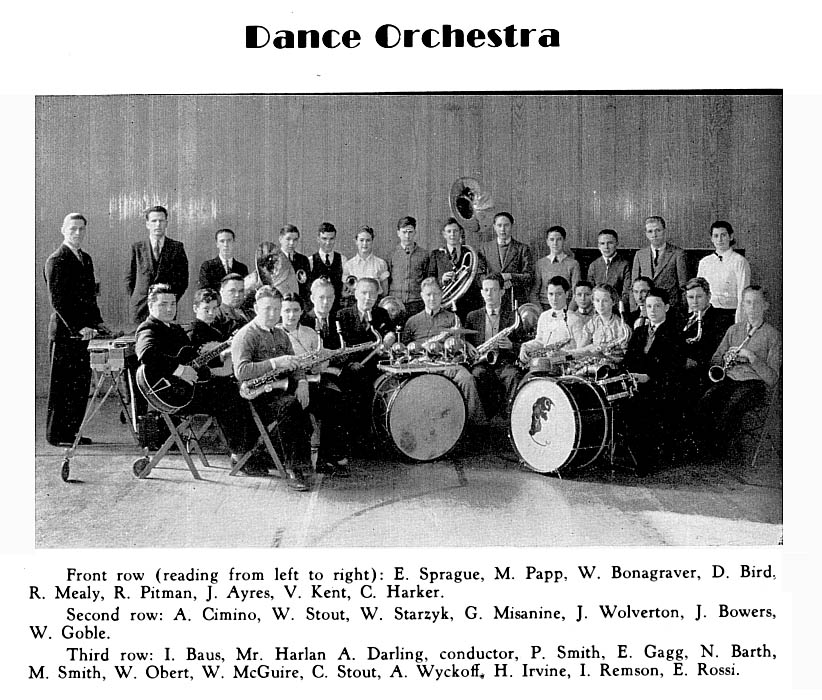
Hamilton High School Dance Band - 1935


October, 1935: